Hehe, I am someone who has never read a whole book since childhood… apart from all my textbooks. I have an older sister, and our paths growing up were very similar. When I later compared our personalities and ways of doing things, we seemed to have been cut from exactly the same genetic cloth. But according to my mother, one major difference was that my sister loved reading as a child, while I barely read at all.
Recently, though, something suddenly made me realize the importance of reading. In this post, I want to propose a new way to read books in the AI era and explain why I think it works. 😈
Like my younger self, I am still impatient and a little too eager for quick results. Outside my coursework, however, I prefer articles and books about economics, social analysis, philosophy, institutions, and ways of thinking.
Let us start from first principles: what are we trying to get from books that offer broader perspectives?
I reject perfectionism, so I will try to capture only 70% of our reasons for reading these books: we want a jolt to our understanding, through new information and more fundamental ways of thinking.
Everyone has a different distribution of beliefs about how the world works, and a different value system. Our decisions depend on the information we already have—which shapes that distribution—and our surroundings. We know this, so we want to sample the views of more experienced people to train and fit our own distributions. That is why we enjoy those moments when a book jolts our understanding.
The method is simple: give ChatGPT the titles of some classic books, then use prompts like these to quickly extract their ideas. These are prompts I have actually used:
I would like to read Fei Xiaotong’s The Institution of Reproduction with you.

Summarize the book’s important arguments, views, ways of thinking, and conceptual frameworks, including approaches you think I should adopt.

Introduce the backgrounds of the authors and the books.

Search the internet and summarize the book’s subsequent influence, standing, and reception.

Give me some classic examples from these books. This would help me get into the subject: I am still young and do not have much intuition for these topics, so I do not understand why these theories emerged. My current impression is that there may not be much science in this field. But I know I am wrong, so examples that challenge my understanding would really interest me!

Summarize readers’ reactions from online reviews. What did this book actually leave behind? Which concepts or ways of thinking entered later academic and public discussions?

Find high-quality online book reviews. Look for reviewers who explain how the book changed their thinking, work methods, or decisions in life. Extract those practical applications and show them to me.
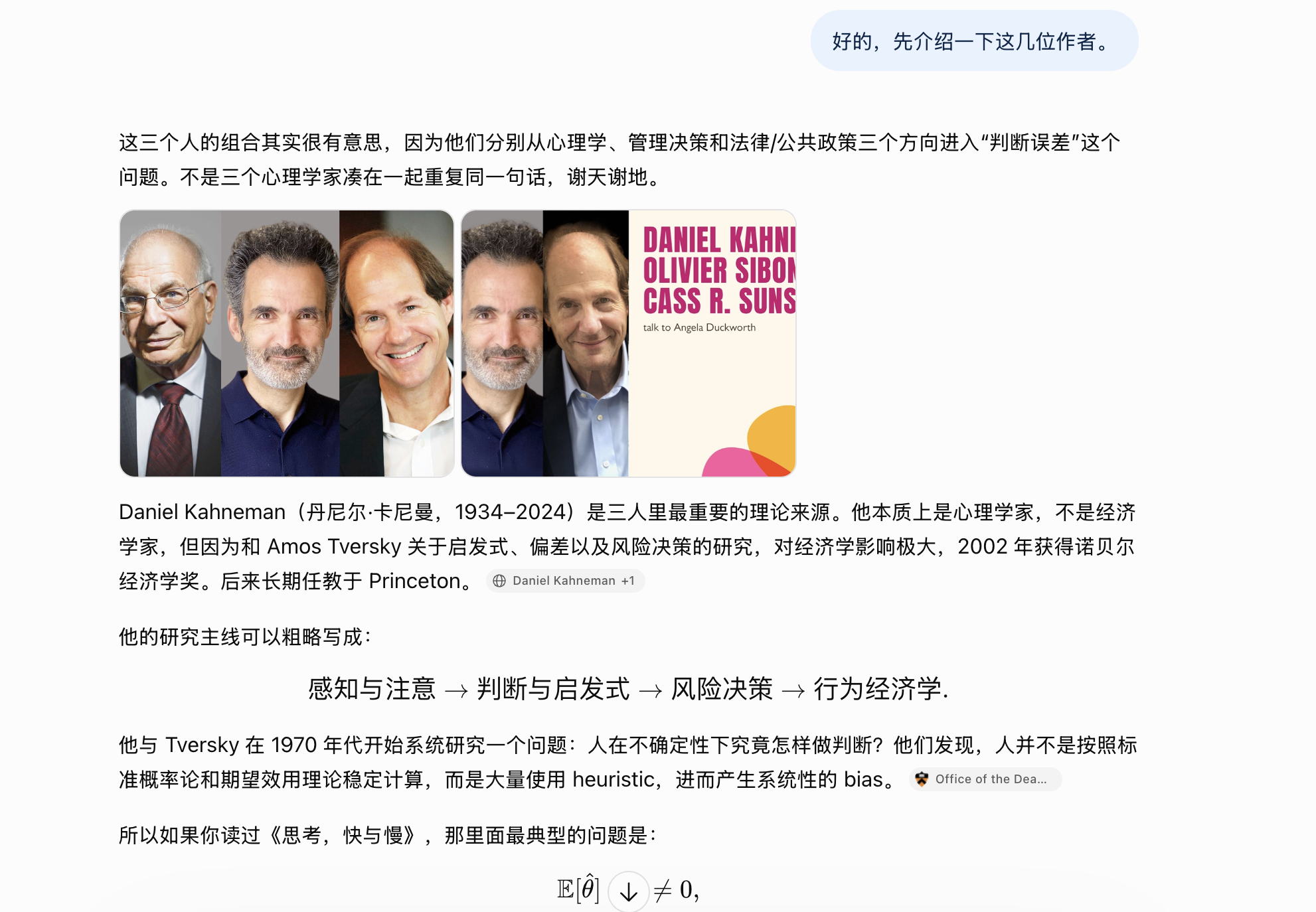
With this approach, I suspect you might absorb 50% of a book’s wisdom in an hour, and perhaps 70% with another hour.
Let me briefly explain why I recommend it and why I think it has a rational basis. Many of the arguments below are also principles I use when analyzing problems, and are interesting in their own right. Take whatever is useful to you!
Starting from the desire for a jolt to our understanding
First, what is this human experience of a cognitive jolt, at its core? My view is:
A jolt is compression.
In other words, we can understand it through distributions, probability, and information theory.
You may have heard the idea that intelligence is compression. Let me introduce information and compression with a simple example. During a recent Coffee Chat with a fellow USTC student—a little advertisement, hehe 🥰: you are welcome to arrange more Coffee Chats with me—he introduced an interesting term: Kolmogorov complexity. The Kolmogorov complexity K(x) is the length of the shortest program that generates a string x. More broadly, the information in something can be described as the minimum amount of text needed to describe it: more text means more information.
He gave me a good example, suggesting we look at these two strings:
First:  010101010101010101010101010101010101

Second: 101100010110011101000101100101010101
Try answering these questions: how would you describe the first string to someone else, using natural language or code? How would you describe the second?
The first can be described as “repeat ‘01’ eighteen times.” It therefore has little information, low complexity, and is compressible.
As for describing the second, I have no idea either 😰😰. That suggests it has a lot of information and high complexity. It defeats my brain’s computing power and leaves me helpless, right? I even feel it may be incompressible in some sense.
The information in something depends on how far you can compress it: the further you can go, the less information it contains. Perhaps we also call someone intelligent when they express more complex phenomena with fewer words. This compression is wisdom itself—just as we were all clever enough to describe the first string in a few words.
Returning to reading: much of the purpose of these books is to help us compress the phenomena we encounter and organize what we already know. The moment a book, or our own response to it, organizes more complex phenomena precisely in fewer words is the moment of cognitive impact. Books about economics, philosophy, institutions, and society are often not very compressed themselves. Authors approach a subject from many dimensions, with considerable explanatory redundancy and relatively low overall information density. These books are therefore well suited to being compressed once more by AI, using appropriate prompts. That improves the information efficiency of acquiring knowledge, which is the rationale behind this method.
Following this reasoning, the method does not suit romance novels, science fiction, or historical narratives in the same way. Reading fiction is also about the experience of the reading process, rather than simply seeking a cognitive jolt. Historical books, in my view, are already highly compressed and cannot be compressed again through an AI layer. Every sentence is irreplaceable: imagine being given a timeline—how could you compress it further? Removing a line would lose information.
You can also apply this logic to doing well on an undergraduate exam. Relative to what an exam tests, textbooks are not highly compressed either.
Information efficiency
Let us discuss information efficiency a little, hehe. I think this is a useful perspective for students in the AI era: guide your decisions by information efficiency. Time is limited, and we cannot learn every point of knowledge. I suggest changing the optimization objective of learning to acquiring as much high-quality information as possible within a limited amount of time.
When GPT first appeared in 2022 and 2023, I had a habit in conversations with it: I wanted to understand every single word. That was my perfectionism at work! Reflecting on it later, I realized perfectionism can reduce information efficiency. Extracting 80% of the ideas from a conversation is very quick: a glance often reveals the key points. But perfecting the remaining 20% can take a long time. This is diminishing marginal returns, and those last 20% have low information efficiency.
So I now put something in GPT’s system prompt asking for responses that are “information-dense without losing information.” That means fewer silly metaphors and more useful content. I also read selectively and quickly, extracting what I need rather than reading every word. Being afraid of missing out is not a good quality; we will always lose something. What we can do is optimize statistically: acquire more high-quality information in less time. Pursuing greater information efficiency is enough. That is the best we can do in learning.
Of course, the human brain also has a limit on the information density it can handle, hahaha. Excessively compressed information is tiring. Still, this is an interesting perspective, and everyone can find their own balance.
Returning to books, this supports my argument: information compressed by AI can be denser than what we get by reading the book directly. We must consciously do the division. Reading an entire book certainly has benefits, but divide those benefits by the 200 hours spent before judging the return.
Broad reading and close reading in the AI era
This summer I asked many friends: in the AI era, would broadly reading 100 papers in a week be more rewarding than closely reading five? This is an open question. I lean toward yes. I later realized that this also fits how I have approached my undergraduate education: I want to become someone with a little knowledge of many fields and a more comprehensive understanding. I prefer random exploration now, rather than getting stuck on narrow problems as I did in high school.
Perhaps breadth of knowledge is becoming more important than depth in the AI era.
AI makes execution cheap. What becomes more valuable is combining ideas, trying them quickly, finding where the returns are, and increasing the frequency of reinforcement learning. I look forward to having tools from all sorts of fields in my head: computing, mathematics, finance, the humanities and social sciences, human nature…
My view is that AI will replace execution in computing first, then mathematics. Once these two foundations are overcome, much of the technology sector could, in principle, be replaced. Computing already makes this clear: writing code is execution, and code has become cheap. What matters now is how to organize and combine tools and abstractions—operating systems, the cloud, programming languages, communications, GPUs, CPUs, servers, software, interfaces, APIs, protocols, environments, security, frontends and backends, data formats, and so on.
One possible project:
How could we automatically collect homework from a QQ group, use AI to produce the PDF, and email it to the teaching assistant?
The function is simple: QQ-group homework goes in, an email goes out. You only need to break down how the tools should be used along the way. Execution—writing the code—is cheap and fast in the era of vibe coding.
That is why I have always thought people with an engineering mindset remain valuable in computing. They can write better prompts that help AI select appropriate tools and solve problems faster.
The more tools we understand, the more combinations we can make. Combined with low trial-and-error costs, that may lead to better returns in the AI era.
The same question applies to books: as intelligence becomes cheaper, which matters more, broad reading or close reading? If you have one month, would broadly reading 100 books with this AI method benefit you more than closely reading three? I think this is an open optimization problem. The answer might be: closely read one book and broadly read 66…
- Event — Slavoj Žižek
- The Conquest of Happiness — Bertrand Russell
- The Age of the Great Turning — Giulia Guarnieri (title rendered from the Chinese)
- Utopia — Thomas More
- The Crowd — Gustave Le Bon
- From the Soil — Fei Xiaotong
- Noise — Daniel Kahneman, Olivier Sibony, and Cass Sunstein
- Principles — Ray Dalio
- You’re About to Make a Terrible Mistake! — Olivier Sibony
- How Countries Go Broke: The Big Cycle — Ray Dalio
- The Human Condition — Hannah Arendt
- Negotiation — author to be confirmed
- The Institution of Reproduction — Fei Xiaotong