Mathematics Has Not Been Exhausted: A Golden Age for Today’s Mathematicians!
Mathematics under one nuclear bombardment after another.
There are seven Millennium Prize Problems, each carrying a million-dollar prize. They are enormously important, heavyweight conjectures for humanity. Each may be beyond the level of a Fields Medal.
In May 2026, an OpenAI model found a counterexample overturning the 87-year-old Erdős unit-distance conjecture, with Fields Medalist Tsimerman and others involved in verification.
On July 19, Anthropic’s Fable 5 found another counterexample, disproving the century-old Jacobian conjecture.
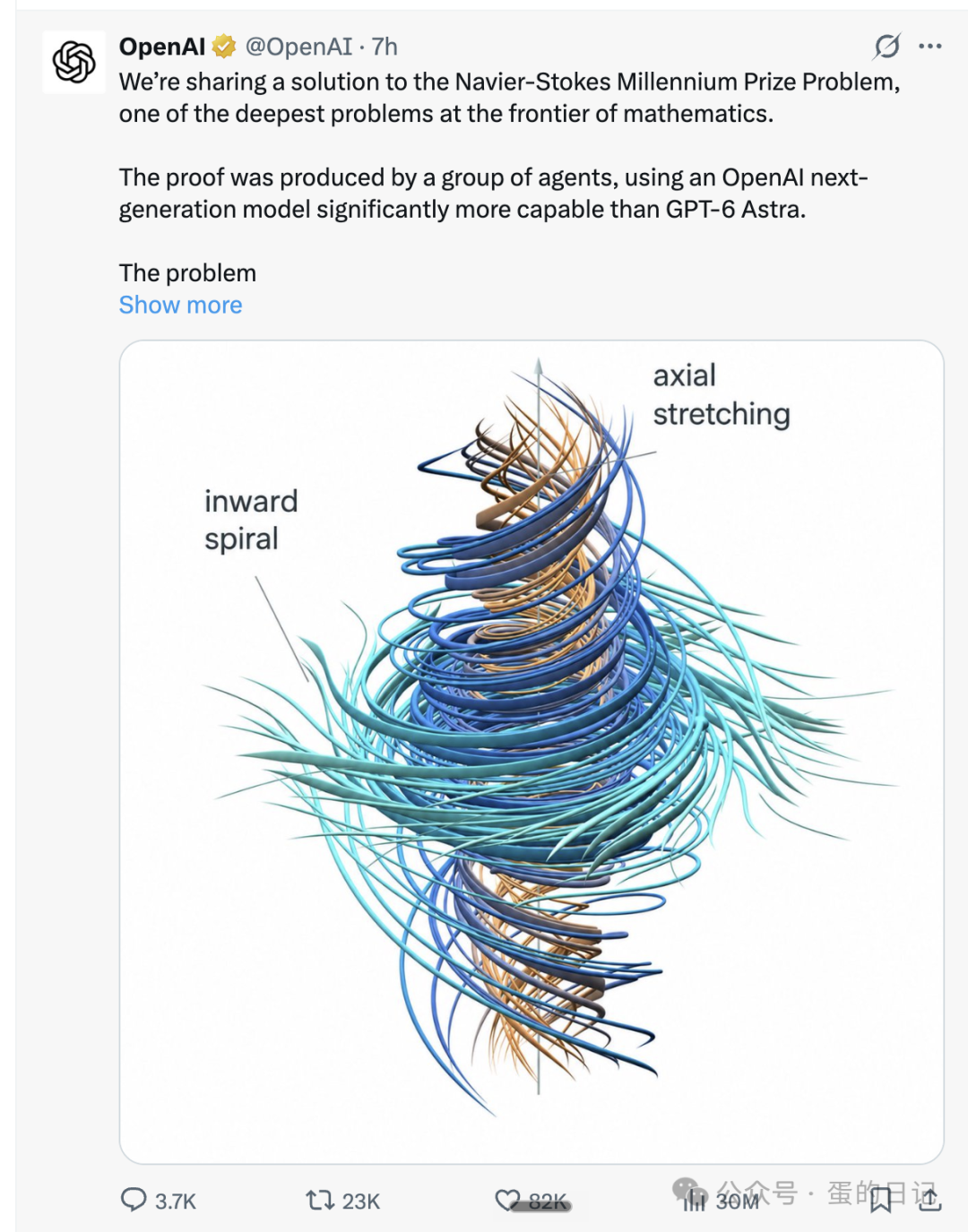
On September 8, OpenAI announced a solution to the Navier–Stokes equations—one of the seven Millennium Prize Problems—and released a 165-page paper and Lean formal-verification code.
On September 10, the Hodge conjecture, another Millennium Prize Problem, reportedly saw a major breakthrough. There were also reports that Anthropic was close to solving the Birch and Swinnerton-Dyer conjecture.
The overall trajectory of AI is this: first computing was overcome, and now mathematics is being overcome. Computing is the foundation of engineering; mathematics is the foundation of science. Once both have been overcome, other intellectual industries could theoretically be overcome as well.
But mathematics and computing differ in essential ways. Mathematics has unlimited capacity, whereas code only needs to meet human demand; beyond that, there is no further market, making it a finite field. In mathematics, unless we have found the universe’s ultimate laws, we can always generate endless problems, produce endless proofs, develop endless applications, and supply endless tools and productivity. If the universe’s ultimate laws are found, humanity will have achieved communism.
So I strongly disagree with the pessimism about mathematics as a field, and about mathematicians. I believe this is a springtime for mathematicians and for mathematics itself.
At its source, mathematics still faces these questions:
- How do we ask a good question?
- How do we solve these questions?
- What insights and applications can their solutions bring? How can they connect with industry to improve human productivity—in signal processing, time-series analysis, cryptography, machine-learning training, industrial manufacturing, or even the ultimate laws of the universe—and thereby improve the welfare of all humanity?
This moment is therefore very good for mathematics. We still have questions one and three to address. They are as difficult as question two, and certainly not simple. How do we produce another batch of high-quality Millennium-level conjectures? If a blow-up solution of the Navier–Stokes equations has been found, can it have industrial applications? These two questions are still being considered by humans. In the future, AI will certainly have to revisit both, so AI × Math still has a way to go.
When will the whole process be complete? My criterion is this: mathematics becomes a fully automated field that continuously provides material benefits to humanity. It starts by generating questions, then solves them, then produces new insights, and connects those insights to automated machinery in the relevant industries. Beyond that point, it is no longer within mathematics itself.
At the current pace, though, these problems may only sustain us for a few more years. What makes me anxious is the feeling that I may not get my turn. My mathematical ability, engineering skills, and network are still limited. I do not see an opportunity to enter the field, nor do I have the ability to attract financial backing.
Still, it is an honor to witness this great era… Its surreal quality makes me feel that I must be living inside a game console in some external space, following a storyline I chose myself.